


Around 70% of adults report experiencing at least one traumatic event in their lifetime. But today, the word “trauma” gets used for traffic jams, awkward conversations, and hard childhoods equally. That’s a problem. When you label everything as trauma, you make the word meaningless — and you might be making your own progress harder. What that actually costs you is worth understanding.
- What “Trauma” Actually Means (And What It Doesn’t)
- How “Trauma” Became a Word for Everything
- Why Calling Everything Trauma Feels Psychologically True
- The Real Cost of Labeling Every Hard Thing as Trauma
- Why Trauma Explanations Can Become an Excuse to Stop Trying
- How to Talk About Trauma Without Letting the Label Define You
- People Also Ask
- Can Overusing “Trauma” Actually Make Recovery Harder Over Time?
- How Does Social Media Exposure Change What People Label as Trauma?
- Does Calling Stress “Trauma” Lower a Person’s Confidence to Cope?
- What Language Should Replace “Trauma” When Describing Everyday Hardships?
- Is Resilience After Difficult Events More Common Than People Typically Believe?
- The Bottom Line
- References
What “Trauma” Actually Means (And What It Doesn’t)

The word “trauma” has a clinical definition. It’s not a feeling. It’s not a synonym for hard or painful. Psychological frameworks define trauma as exposure to actual or threatened death, serious injury, or sexual violence. That exposure then produces a specific pattern of symptoms: intrusive memories, avoidance, mood changes, and hyperarousal. Those symptoms must persist beyond one month and cause real functional impairment.
Trauma misconceptions are common. Many people use the word to describe stress, disappointment, or emotional pain. That usage isn’t just imprecise. It distorts symptom interpretation and can lead you toward the wrong conclusions about what you’re experiencing.
A breakup is painful. Job loss is destabilizing. But neither automatically meets diagnostic criteria. Calling them trauma doesn’t make them easier to process. It can actually make accurate treatment harder to access.
Understanding the actual trauma definition matters. It helps you find the right framework for what’s real. Emotional pain is an adaptive signal that calls for care and reflection, not a diagnostic marker of psychological damage. When emotional pain is mislabeled as trauma, it can promote a sense of fragility and create unrealistic expectations about how healing should unfold.
How “Trauma” Became a Word for Everything
You didn’t always use the word “trauma” to describe a hard week or a frustrating conversation.
The word once had a specific clinical meaning, tied to events that overwhelmed a person’s ability to cope and left lasting psychological damage.
Now social media platforms and popular books apply it to nearly any form of discomfort, and that repeated misuse has quietly stripped the word of its original precision. This matters because mislabeling emotional suffering as trauma can actually interfere with finding the right kind of help.
The term has exploded in usage, growing from roughly 3,000 mentions between 1980 and 1990 to over 66,000 mentions between 2015 and 2025.
Word’s Original Meaning Lost
“Trauma” once had a specific meaning. It described exposure to events that threatened life or physical safety. Clinicians used it to identify a narrow set of experiences that could produce measurable psychological harm. That semantic specificity mattered. It shaped diagnoses, guided treatment, and made research comparable across studies.
Then linguistic drift took over. The word moved out of clinical settings and into everyday conversation. People started calling breakups traumatic. Difficult childhoods. Hard weeks at work. Each use stretched the meaning a little further. Eventually the word lost its diagnostic edges entirely.
You now live in a culture where “trauma” explains almost everything. That’s a problem. When a word means everything, it means nothing. And a term that means nothing can’t help you figure out what’s actually wrong. Clinical trauma alters brain structure, specifically affecting the hippocampus, amygdala, and prefrontal cortex in ways that minor life inconveniences simply do not.
Research consistently shows that most people are resilient following genuinely traumatic events, returning to stable functioning without developing chronic impairment, which makes the blanket application of the trauma label to ordinary hardship even harder to justify.
Media Normalizes Overuse
Once clinical language left the clinic, media platforms turned it into content. Podcast hosts applied it to breakups. Memoir covers promised healing journeys. Headlines reduced complex diagnoses to three-word captions. That’s media saturation working exactly as designed.
Clickbait culture rewards simplified emotional language. A post titled “Signs You Have Trauma” outperforms one with clinical nuance. Platforms don’t correct that imbalance. They accelerate it.
Semantic oversimplification follows naturally. The word gets used so broadly that it stops meaning anything specific.
That creates diagnostic ambiguity for both patients and clinicians. Therapists now spend intake sessions untangling what a client actually means when they use the word.
You absorbed this framing from content you watched, read, and shared. The media didn’t inform you. It conditioned you. Social media trends like the hashtag #trauma have contributed to suggesting that everyday difficulties are comparable to genuine traumatic experiences.
Why Calling Everything Trauma Feels Psychologically True
When you experience something painful, your brain immediately searches for an explanation.
That search is automatic, and it tends to favor whatever label feels most complete.
“Trauma” offers that completeness because it names the pain, assigns it a cause, and tells you it makes sense.
But researchers like Richter-Levin et al. (2021) argue that the term should be reserved for experiences that genuinely overwhelm coping abilities, not simply those that cause discomfort.
When Pain Seeks Meaning
Pain that has no name is harder to carry. So your brain finds one. This is how meaning-making strategies work. You take a scattered, uncomfortable experience and build a story around it. That story creates narrative coherence. It connects events into a sequence with a cause and a reason.
Once the story holds together, the distress feels more manageable.
Calling something trauma does exactly that. It names the pain. It explains the symptoms. It tells you why you feel the way you do.
That explanation feels true because it works. It reduces uncertainty. It gives you a frame.
But feeling true and being accurate aren’t the same thing. The brain prefers a coherent story. It doesn’t require a correct one. Diagnostic labels carry identity-shaping power that can cause individuals to adjust their self-concept and behavior to align with the category they’ve been given.
Most painful experiences actually heal naturally, and trauma occurs when key resolution processes are disrupted rather than simply because a difficult event took place.
The Brain’s Labeling Reflex
Your brain doesn’t label emotions to be accurate. It labels them to manage them.
When you name an emotional state, your prefrontal cortex activates and your amygdala quiets down. That’s labeling effects doing exactly what they’re built to do — reducing threat and creating a sense of control. It works. That’s the problem.
Emotional regulation through naming feels like clarity. It isn’t always.
Once a label sticks, your brain reinforces it. Memory consolidates around it. Future experiences get filtered through it. The label stops being a tool and starts being a lens.
Calling something trauma doesn’t just describe what happened. It changes how your brain stores and retrieves it. The word does neurological work. That work continues long after you first use it.
The Real Cost of Labeling Every Hard Thing as Trauma
Language shapes how systems respond. When trauma misconceptions flood clinical settings, diagnostic accuracy drops. Clinicians can’t distinguish a genuine PTSD case from ordinary stress if both carry the same label. That confusion has real costs.
Mental health resources aren’t unlimited. Waitlists for evidence-based treatments like EMDR and prolonged exposure grow longer when referrals include people who don’t meet clinical criteria. People with actual trauma disorders wait longer.
Intervention effectiveness falls when the wrong tools get applied to the wrong problems. Resource allocation suffers at the population level too.
Planning breaks down when prevalence data are inflated by overlabeling. There’s a personal cost as well. Adopting a trauma identity for normative adversity shapes identity expectations in ways that reduce adaptive coping.
It can also produce stigma effects that work against real survivors by making the term feel ordinary. Clinical implications reach further than most people realize.
Why Trauma Explanations Can Become an Excuse to Stop Trying
There’s a difference between understanding why you struggle and using that understanding to avoid change. One builds awareness. The other builds a ceiling.
Trauma justification happens when explanation replaces action. You understand the source of your pain. That understanding then becomes the reason you don’t try.
Research shows that attributing problems to permanent and uncontrollable causes reduces effort and persistence. It’s not a character flaw. It’s a predictable psychological pattern.
Motivation decline follows. When you believe your past determines your present capacity, you stop initiating new strategies. You avoid graded challenges. You skip the behavioral experiments that actually build confidence.
Studies confirm that lower perceived self-efficacy leads directly to reduced goal-directed behavior.
Validation of suffering matters. But validation without activation stalls recovery. The evidence is clear: people who shift toward specific and controllable explanations engage more and improve more.
Understanding your history is the starting point. It’s not the stopping point.
How to Talk About Trauma Without Letting the Label Define You
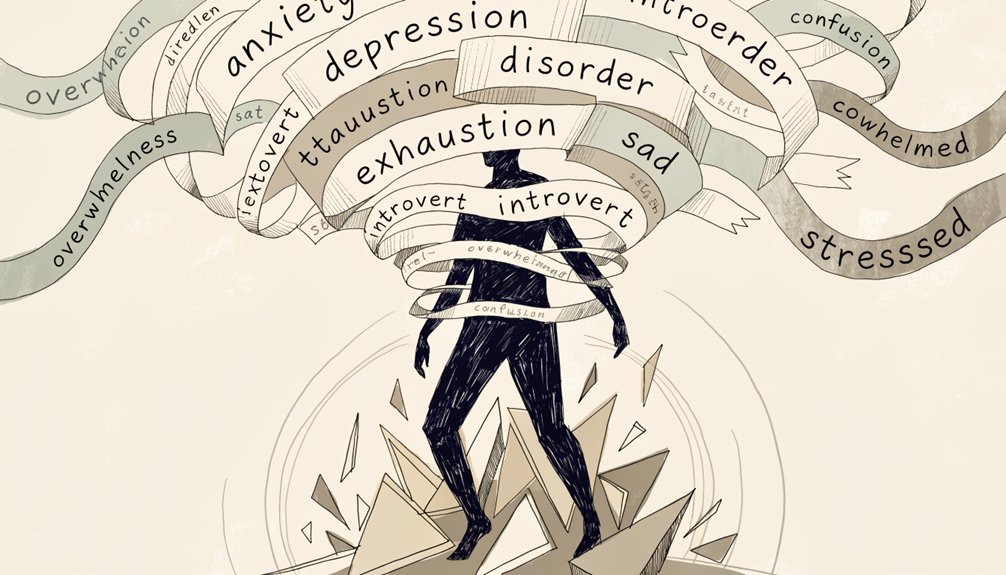
Words shape how you understand yourself. Trauma language is useful when it’s accurate. It becomes a problem when it replaces identity exploration with a fixed label.
You can describe your emotional responses without building your entire self-concept around them. “I struggle with trust” is more precise than “I’m traumatized.” One points to a behavior. The other defines a person.
Coping strategies work better when you frame them as skills you’re building. Resilience discussions go further when they acknowledge what you’ve handled without treating difficulty as your core identity.
Therapeutic framing matters here. Psychological flexibility means you can hold defining experiences as part of your story without letting them become the whole story.
Cultural contexts affect how people narrate hardship. Personal narratives shift over time. A label that feels accurate today may limit you tomorrow.
Use clinical language when it’s clinically warranted. Otherwise, describe what happened and what you’re doing about it.
People Also Ask
Can Overusing “Trauma” Actually Make Recovery Harder Over Time?
Yes, overusing “trauma” can slow your recovery. Trauma dilution blurs emotional clarity, making it harder for you to identify what you’re truly experiencing and engage in the active coping strategies that actually help you heal.
How Does Social Media Exposure Change What People Label as Trauma?
Like a drumbeat you can’t unhear, social media rewires your emotional labeling through trauma normalization, reshaping public perception and mental health discussions until narrative influence stretches ordinary stress into trauma, warping your coping mechanisms with borrowed emotional language.
Does Calling Stress “Trauma” Lower a Person’s Confidence to Cope?
Yes, labeling stress “trauma” can lower your confidence to cope. When you use heavy psychological labels, you weaken your emotional intelligence, shrink your coping strategies, and undermine your stress management capacity.
What Language Should Replace “Trauma” When Describing Everyday Hardships?
Words shape your world—so replace “trauma” with “situational stressor,” “adjustment reaction,” or “emotional burden.” You’ll strengthen your life challenges, emotional resilience, stress management, and coping strategies by naming what’s actually happening with precision.
Is Resilience After Difficult Events More Common Than People Typically Believe?
Yes, resilience after difficult events is more common than you think. You likely possess natural coping mechanisms and resilience strategies that support post-adversity wellness, quietly enabling emotional growth without you even recognizing it.
The Bottom Line
You don’t have to throw out the word trauma. You just can’t let it be the last word. A label is a starting point, not a destination. When you treat it like an answer, you stop asking better questions. Your history shaped you. It doesn’t own you. Name what happened, then move. The map isn’t the territory — knowing the terrain is only useful if you’re willing to walk.
References
- https://www.psychologytoday.com/au/blog/traumatization-and-its-aftermath/202508/the-hidden-danger-of-trauma-culture
- https://search.proquest.com/openview/30ca9fa7d03695410857a2e8cac25446/1.pdf?pq-origsite=gscholar&cbl=2026616
- https://www.nature.com/articles/s41398-021-01514-4/
- https://psycnet.apa.org/manuscript/2022-20702-001.pdf
- https://www.psychologytoday.com/us/blog/traumatization-and-its-aftermath/202511/the-trauma-era-from-awareness-to-misunderstanding
- https://www.psychologytoday.com/us/blog/traumatization-and-its-aftermath/202511/why-calling-everything-trauma-makes-healing-harder
- https://www.psychologytoday.com/us/blog/traumatization-and-its-aftermath/202512/why-trauma-is-not-what-most-of-us-think-it-is
- https://www.psychologytoday.com/us/blog/traumatization-and-its-aftermath/202405/7-myths-about-trauma
- https://www.psychologytoday.com/us/blog/traumatization-and-its-aftermath/202508/the-hidden-danger-of-trauma-culture
- http://www.theguardian.com/us-news/ng-interactive/2025/dec/14/trauma-mental-health